One Million Midwives to Deliver Feminist Health Systems: Reflections from Women Deliver 2026
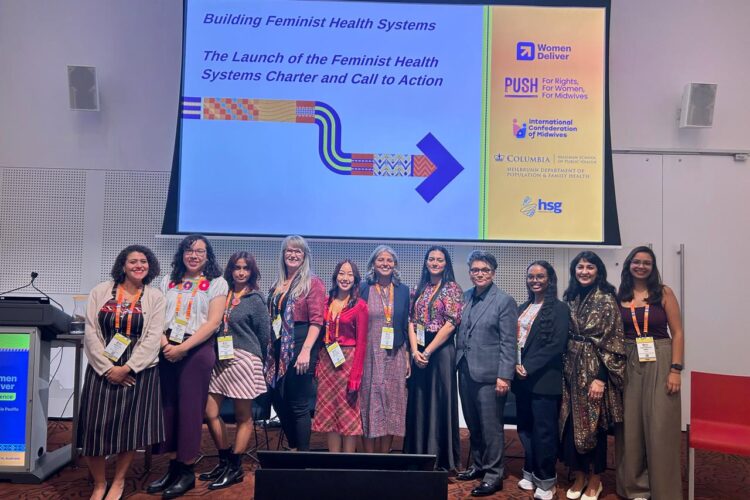
At Women Deliver 2026 in Naarm (Melbourne), Australia, the ICM brought the voice of midwives to the largest convening on gender equality.
Our message was clear: Investing in midwives and woman-centred care is the key to transforming health systems to uphold dignity, rights, and justice. Across multiple high-level events and panels, we highlighted the role the most feminist health professionals play in health systems transformation, climate justice, and maternal and newborn survival.
Launching the Charter for Feminist Health Systems
A major highlight of the conference was the launch of the Feminist Health Systems Charter and Call to Action.
Hosted by Women Deliver, the PUSH Campaign hosted by ICM, Columbia University Mailman School of Public Health’s Heilbrunn Department of Population and Family Health, and Health Systems Global’s Thematic Working Group on Gender and Health Systems, the launch brought together midwives, doctors, advocates, researchers, youth leaders, and policymakers committed to reimagining health systems through a feminist lens. The lived experiences of this powerful intergenerational panel encompassing service deliver, humanitarian crises, LGBTQIA+ inclusion, disability justice, adolescent health, data equity, and government, speakers highlighted the urgent need for health systems grounded in dignity, autonomy, accountability, and community leadership.
Midwives featured in the Closing Ceremony
As part of the co-authors of the Charter on Feminist Health Systems, ICM was invited to be present the Charter at the closing ceremony. We proudly called over 6000 gender equality advocates to join the movement and close the One Million Midwife Gap as a practical step to build feminist health systems.
“The Charter is an advocacy tool, offering 12 feminist principles, and the respective legal obligations for States to abide by international human rights law and to respect, protect, and fulfill the right of everyone to the highest attainable standard of physical and mental health. The right to health is not optional. Health is our leverage for justice.” ~ Merette Khalil, PUSH Campaign Lead, ICM at WD2026 Closing Ceremony
The Charter for Feminist Health Systems responds to growing inequities in global health systems and the increasing backlash against gender equality and bodily autonomy. It recognizes that health systems are not neutral: they are shaped by political, economic, and social power structures that too often exclude and marginalize women, girls, gender-diverse people, people with disabilities, and frontline communities. ICM, through the PUSH Campaign, emphasized the critical role of midwives in delivering feminist health systems in practice. Midwives provide far more than clinical care — they advocate for respectful and evidence-based care, bodily autonomy, informed choice, and community-centered approaches that uphold trust and dignity.
ICM also contributed to three major sessions during the conference.
Midwives as THE Innovation to Closing Maternal & Newborn Mortality Gap
Firstly, ICM participated in the high-level side event Proven Innovations to Scaled Delivery: Closing the Maternal & Newborn Mortality Gap, hosted by the Gates Foundation. The session brought together researchers, innovators, policymakers, and advocates to showcase evidence-based innovations capable of accelerating progress in maternal and newborn health.
Representing ICM’s PUSH Campaign, Merette Khalil delivered a lightning talk on “Unlocking Midwives: Delivering Innovation at the Last Mile.” The intervention emphasized that innovations are only as effective as the workforce able to deliver them, and called for sustained investment in midwives as essential providers, advocates, and leaders within health systems. From AI-enabled screening tools to breakthroughs in anemia and preeclampsia care, scaling innovation requires sustained investment in midwives, the guaranteed innovation to avert more than two-thirds of maternal and newborn deaths.
Saving Mothers and Babies: Midwives Critical in Every Crisis
In The Mothers and Babies Mortality Crisis, ICM joined partners from across the humanitarian, climate, and global health sectors to address the disproportionate burden of maternal and newborn deaths in fragile and crisis-affected settings. Today, humanitarian settings account for 58% of global maternal deaths. ICM joined experts including, the Partnership for Maternal, Newborn & Child Health (PMNCH), Gavi, the Vaccine Alliance, International Rescue Committee, International Federation of Red Cross and Red Crescent Societies, World Health Organization, UNICEF, United Nations Population Fund, Médecins Sans Frontières, and regional climate and community organizations. The session highlighted the urgent need to invest in frontline and community-led solutions, especially midwives, particularly in contexts shaped by conflict and climate change.
Midwives at the Center of the Gender-Climate Package for COP31 and Beyond
In the roundtable Designing the Gender-Climate Package for COP31 and Beyond, ICM joined governments, civil society organizations, multilaterals, philanthropies, and climate finance actors to discuss pathways toward gender-responsive climate financing and policy reform. ICM contributed to discussions on gender-responsive climate finance and the need to ensure women, frontline workers, and women-led organizations (including midwives and midwifery associations) are meaningfully included in climate adaptation and financing strategies. The conversation reinforced the growing recognition that climate justice, gender equality, and health are deeply interconnected — and that midwives are critical responders and health systems stabilizers in climate-related crises.
Throughout Women Deliver 2026, ICM reinforced that midwives are central to advancing equitable, resilient, and rights-based health systems. As the global community looks ahead to key moments including the UN General Assembly and COP31, ICM continues to advocate for the investments, policies, and partnerships needed to ensure that every woman and newborn has access to quality, respectful care — everywhere.