Midwives Front and Centre at WHA: Calling for a Global Transition to Midwifery Models of Care
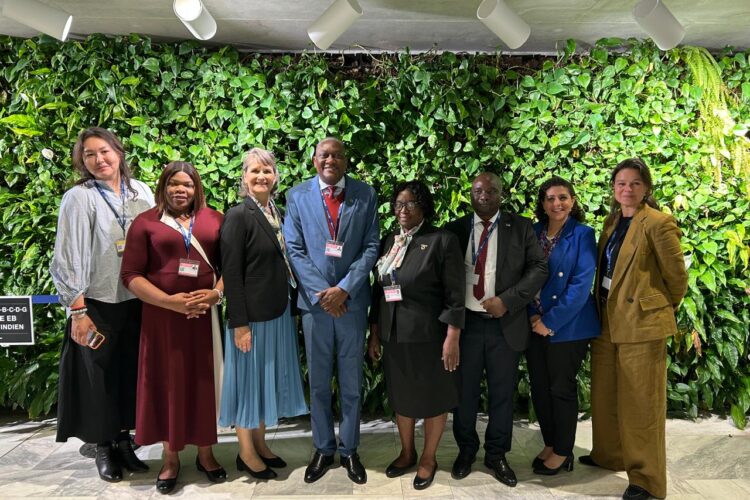
During this year’s Seventy-Ninth World Health Assembly (WHA) in Geneva, ICM engaged in a dynamic week of high-level advocacy, strategic partnerships and global dialogue to advance midwifery leadership and Midwifery Models of Care (MMoC) as critical pathways towards universal health coverage.
A key highlight of the week was ICM’s official WHA side event.
Official Side Event on Midwifery Models of Care
At WHA, ICM and eight co-sponsoring governments convened the first-ever official WHA side event dedicated to Midwifery Models of Care. The event brought together ministers, UN agencies and civil society leaders to discuss how countries are operationalising midwifery models of care to advance universal health coverage.
Continuity, Respect, Equity: Midwifery Models of Care for People-Centred Health Systems to Achieve Universal Health Coverage was co-hosted by the Governments of Bangladesh, Egypt, Ethiopia, Luxembourg, Nepal, Sweden, the United Kingdom and Zambia, and coordinated by ICM. The hybrid event, held on Monday 18 May, filled the room at WHO Headquarters, with several hundred participants also joining online.
Re-watch the event here or read the detailed summary here.
The event was opened by WHO Director-General Tedros Adhanom Ghebreyesus, who stressed that continuity of care from a known midwife improves outcomes and reduces unnecessary interventions. The opening segment also included a presentation of the evidence by Pascale Allotey, Director of WHO’s Department of Sexual, Reproductive, Maternal, Child, Adolescent Health and Ageing, who emphasised that political leadership, not only guidance, is needed to translate evidence into reform.
ICM’s Chief Executive, Anna af Ugglas, highlighted the global shortage of one million midwives and the lifesaving potential of universal coverage of midwife-delivered care, which could save 4.3 million lives annually.
A high-level roundtable then shifted the conversation from the “why” to the “how”, inviting leaders to present how countries are transitioning to Midwifery Models of Care and what it takes to operationalise this transition.
Zambia’s Permanent Secretary for Technical Services at the Ministry of Health shared how legal reform, workforce investment and the institutionalisation of a Chief Midwife role have contributed to reductions in maternal and neonatal mortality.
Sweden’s Director General for the National Board of Health and Welfare demonstrated how sustained investment in midwives and gender equality, the expansion of midwives’ scope to deliver family planning and sexual and reproductive health services, and the institutionalisation of a Chief Midwifery Officer have helped transform national health outcomes. Today, Sweden has one of the world’s lowest maternal and newborn mortality rates.
Representing civil society and advocates, Magda Robalo, former Minister of Health of Guinea-Bissau, Executive Director of Women in Global Health and Co-Chair of UHC2030, argued that nursing and midwifery require distinct policy and leadership frameworks to ensure that midwifery priorities are not diluted.
UNFPA’s Director of Programmes, Julia Bunting, presented tools available to support countries in their transition to Midwifery Models of Care, including the newly launched Investment Case Framework, the Midwifery Accelerator, the Global Position Paper on Midwifery Models of Care and the Implementation Guidance on transitioning to Midwifery Models of Care.
Zambia’s Chief Midwife, Daphne Shamambo, concluded the event with a strong collective call for WHO and Member States to develop a standalone global midwifery strategy beyond 2030, recognising midwifery as both a distinct profession and a proven model of care essential to reducing maternal and newborn mortality worldwide.
The key takeaway was clear: advancing Midwifery Models of Care and investing in midwives is essential to achieving universal health coverage and reducing preventable maternal and newborn deaths worldwide.
Walk the Talk for One Million More Midwives
On Sunday 17 May, ICM joined the annual Walk the Talk at the Palais des Nations with a clear advocacy message: if we are serious about reducing maternal and newborn deaths, meeting unmet reproductive health needs, and delivering universal health coverage and health for all, we must close the million-midwife gap.
ICM joined the Partnership for Maternal, Newborn, Child and Adolescent Health’s booth to raise awareness and invite delegates to sign the One Million More Midwives petition.
ICM’s Participation in High-Level Panels: Advancing Midwifery Leadership
Led by Chief Executive Anna af Ugglas and Chief Midwife Jacqueline Dunkley-Bent, the ICM delegation participated in major global convenings, ministerial discussions and strategic partner meetings focused on strengthening maternal and newborn health systems, workforce investment, humanitarian response and gender equality.
On Sunday 17 May, Anna af Ugglas joined PMNCH’s Lives in the Balance series for a high-level dialogue on Health Sovereignty, Financing Reform and Protecting What Matters Most: Women’s, Children’s and Adolescents’ Health. During the discussion, she emphasised the importance of country ownership, sustained investment and midwives as a cost-effective solution for resilient health systems.
On Monday 18 May, ICM contributed to several influential global discussions. Jacqueline Dunkley-Bent spoke at the session Strategic Leadership for Nurses and Midwives: A Policy Pathway to Stronger Health Systems, where she emphasised the importance of midwifery leadership, workforce investment and differentiated policy approaches for nursing and midwifery to strengthen health systems impact.
Jacqueline Dunkley-Bent also joined the panel Simulation-Based Learning to Empower Midwives Across the Humanitarian-Development-Peace Continuum, where she highlighted the essential role of midwives in humanitarian and fragile settings. On Thursday 20 May, she moderated an African Union-European Union dialogue titled From Production to Access: Strengthening Sustainable Supply of SRH Commodities.
Merette Khalil, PUSH Campaign Lead, contributed to an official side event on Women in Global Health Leadership, Equity & Multilateral Action. She reflected on intergenerational leadership and the barriers young women face in global health diplomacy, calling for more meaningful inclusion of women, youth and health workers, especially midwives, in decision-making spaces.
Building Partnerships and Advocating for Midwives
The ICM delegation also engaged in dozens of strategic bilateral meetings with key partners, including the International Council of Nurses, the International Federation of Gynecology and Obstetrics, WHO, Direct Relief, Laerdal Global Health, the International Labour Organization, FCDO, WaterAid and others. These meetings focused on strengthening collaboration across workforce development, interprofessional collaboration, humanitarian health, financing, and sexual and reproductive health and rights.
Meetings with UNFPA and Midwifery Accelerator partners further reinforced momentum towards closing the global shortage of midwives and scaling Midwifery Models of Care globally.
Across every engagement, ICM reinforced a consistent message: investing in midwives and transitioning to Midwifery Models of Care is essential to reducing maternal and newborn mortality, strengthening primary health care, advancing gender equality, and building equitable and resilient health systems worldwide.