Global health associations will launch new partnership for maternal, newborn and child survival
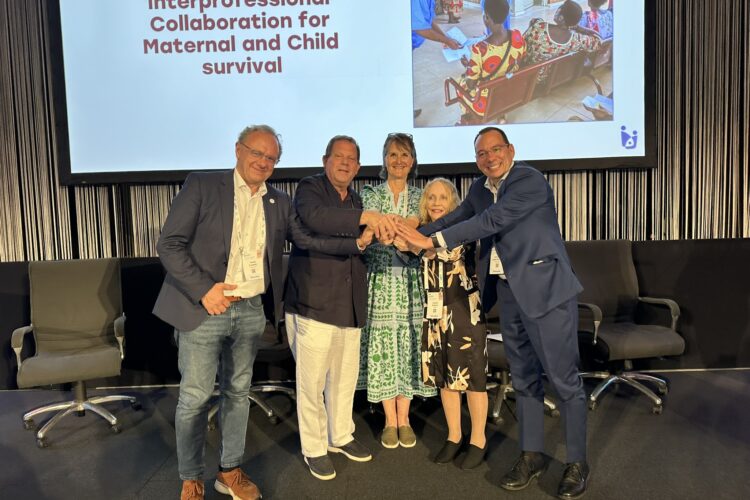
On 15 June 2026, five leading global professional associations working across sexual, reproductive, maternal, newborn, child and adolescent health (SRMNCAH) presented the Global SRMNCAH Professional Association Partnership in Lisbon, Portugal, during the 34th ICM Triennial Congress.
The partnership is bringing together the Council of International Neonatal Nurses (COINN), the International Confederation of Midwives (ICM), the International Council of Nurses (ICN), the International Federation of Gynaecology and Obstetrics (FIGO), and the International Paediatric Association (IPA).
This marks the first time global associations representing midwives, nurses, neonatal nurses, obstetricians, gynaecologists and paediatricians have come together in a structured platform to advance maternal, newborn and child survival in high-burden countries.
The Partnership was presented alongside a Joint Declaration, which sets out a shared agenda to work across professions, strengthen health workforces, and keep maternal, newborn and child survival at the centre of the global health agenda beyond 2030.
Every year, 260,000 women die from largely preventable causes during pregnancy and childbirth, and 2.3 million newborns die in their first weeks of life. These deaths are concentrated in low- and middle-income countries, where health systems continue to face workforce shortages, limited financing and fragmented service delivery.
“Behind these numbers are women, newborns and families whose lives could be saved with access to quality care and a supported health workforce,” said Anna af Ugglas, Chief Executive of the International Confederation of Midwives. “We cannot accept preventable deaths as inevitable, especially when we know what works.”
Progress is also slowing. Sixty-eight countries are off track to meet the 2030 maternal mortality target, and 55 are off track on the neonatal mortality target. With only a few years left before the Sustainable Development Goals come to an end, the Joint Call to Action makes clear that maternal, newborn and child survival must remain a global priority beyond 2030.
“The world cannot afford to lose momentum on maternal and newborn survival after 2030,” said af Ugglas. “The unfinished agenda is too significant, and the consequences of inaction are too great.”
The Partnership will respond to a simple reality: no single profession can solve this challenge alone. By bringing together global associations representing midwives, nurses, neonatal nurses, obstetricians, gynaecologists and paediatricians, it will create a platform for coordinated leadership, advocacy and action to improve outcomes for women, newborns, children and adolescents.
“Women and newborns receive better care when health professionals work together as coordinated teams,” said af Ugglas. “This Partnership recognises that collaboration across professions is essential to achieving lasting improvements in health outcomes.”
Through the Partnership, the five associations intend to use their collective reach to support coordinated action at global, regional and country level. Together, they represent millions of health professionals working in ministries of health, training institutions, health facilities and communities.
The Declaration sets out six priority areas for the Partnership’s work:
- Renew global commitments beyond 2030, ensuring that maternal and newborn survival remains central to future global health frameworks.
- Advocate for sustained investment in the SRMNCAH workforce, including better training, retention, recognition and support for midwives, nurses, obstetricians, gynaecologists, paediatricians and neonatal nurses.
- Promote interprofessional collaboration, including joint capacity-building and team-based approaches to care in high-burden countries.
- Support country-led and evidence-based solutions, recognising that the most effective responses must be shaped by national priorities, local evidence, health workers and communities.
- Unify advocacy and political commitment, bringing a shared professional voice to governments, donors and multilateral agencies.
- Establish shared governance and accountability structures, including joint priority-setting and transparent monitoring of progress.
The Partnership will pay special attention to vulnerable populations, including those affected by humanitarian crises, where access to maternal, newborn and child health services is often disrupted and where health workers need greater support to continue providing lifesaving care.
“Health workers are often the first and last line of support in humanitarian settings,” said af Ugglas. “Strengthening and protecting the workforce is critical if we are to reach those most at risk.”
For ICM, the Partnership reflects a long-standing agenda to collaborate across the health workforce, while ensuring that midwives are recognised as essential providers of sexual, reproductive, maternal, newborn and adolescent health services.
The Declaration invites governments, donors, national and regional professional associations, civil society and the broader global health community to join this agenda. Ending preventable maternal, newborn and child deaths, including stillbirths, will require political will, sustained investment and coordinated action.
As the SDG era draws to a close, the message from the five associations is clear: maternal, newborn and child survival is not a time-bound ambition. It is a matter of rights, equity and shared responsibility.
“Midwives, nurses, doctors and neonatal specialists all have a role to play, but lasting change requires collective action,” said af Ugglas. “Through this Partnership, we are bringing our professions together around a shared goal: ensuring that every woman, newborn and child has the opportunity to survive and thrive.”
Through this new Partnership, the professions closest to women, newborns, children and adolescents will come together to help carry that agenda forward.