
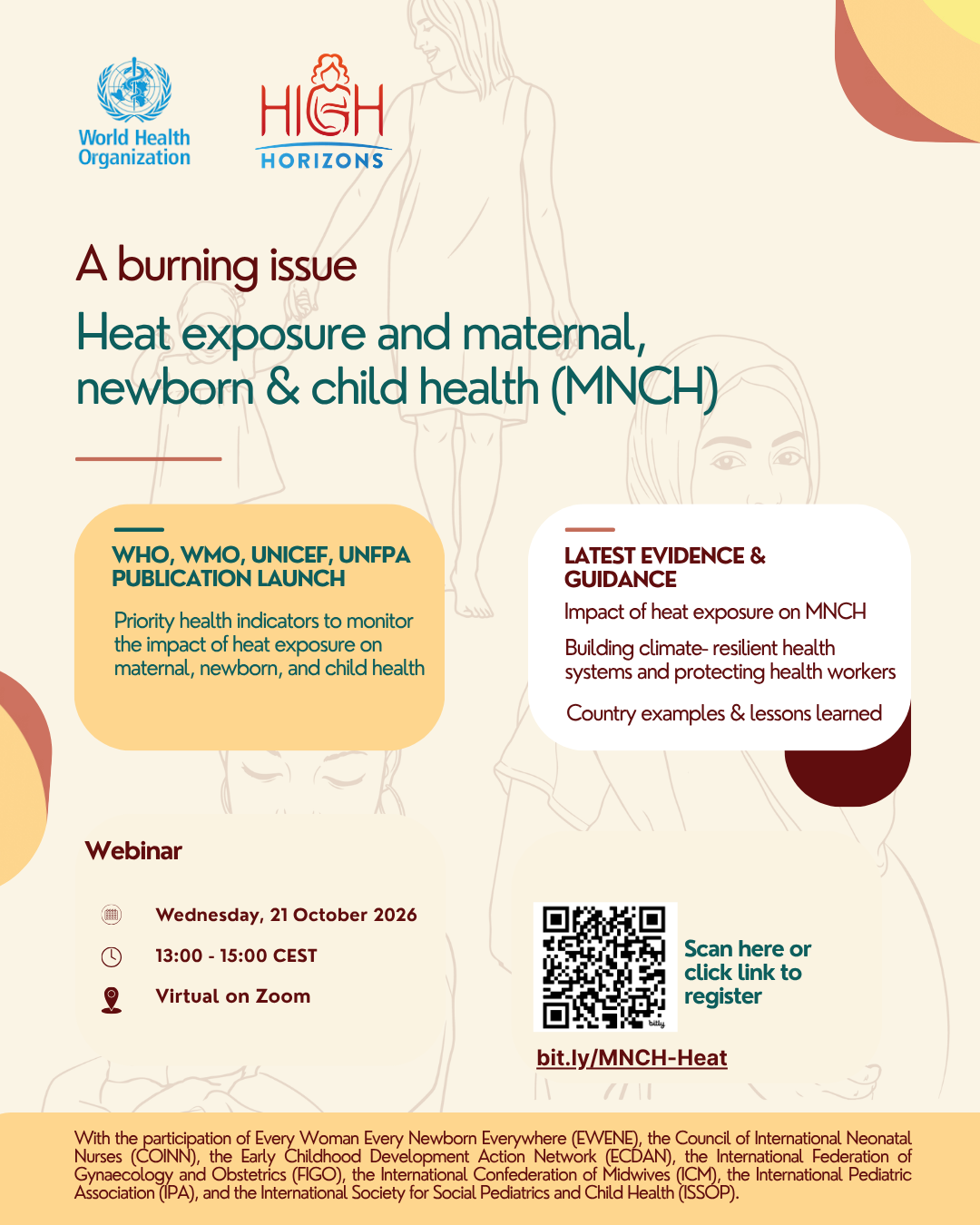
A burning issue: heat exposure and maternal, newborn and child health
 Pregnant and postpartum women, newborns and children are uniquely vulnerable to climate risks owing to a range of anatomical, developmental, physiological, and behavioural factors. As global temperatures rise, heat exposure has become an urgent issue for maternal, newborn and child health (MNCH), especially where temperatures are already high, and in resource-limited settings where infrastructure and resources to reduce heat stress are constrained. With 1.5 billion children facing increasingly frequent, longer or more severe heatwaves, the World Health Organization (WHO), World Meteorological Organization (WMO), United Nations Children’s Fund (UNICEF) and United Nations Population Fund (UNFPA) have identified priority indicators to monitor how extreme heat is affecting pregnant and post-partum women, newborns and children – and urging countries to take action to protect them.
A WHO and HIGH Horizons Webinar
A webinar is planned for Wednesday 21 October 2026, 13:00 – 15:00 CEST – The webinar will present the latest evidence on the impact of heat exposure on MNCH, present priority indicators to measure this impact and share country examples to protect MNCH from heat stress. It will also zoom in on why it is urgent to alleviate heat stress in health facilities, for both service users and health workers. Health professional associations, health workers and decision-makers will share their perspective on what they can do to reduce heat in health facilities and support health workers wellbeing in heat.
With the participation of Every Woman Every Newborn Everywhere (EWENE), the Council of International Neonatal Nurses (COINN), the Early Childhood Development Action Network (ECDAN), the International Federation of Gynaecology and Obstetrics (FIGO), the International Confederation of Midwives (ICM), the International Pediatric Association (IPA), and the International Society for Social Pediatrics and Child Health (ISSOP).