Transitioning to Midwife-Led Models of Care in Afghanistan
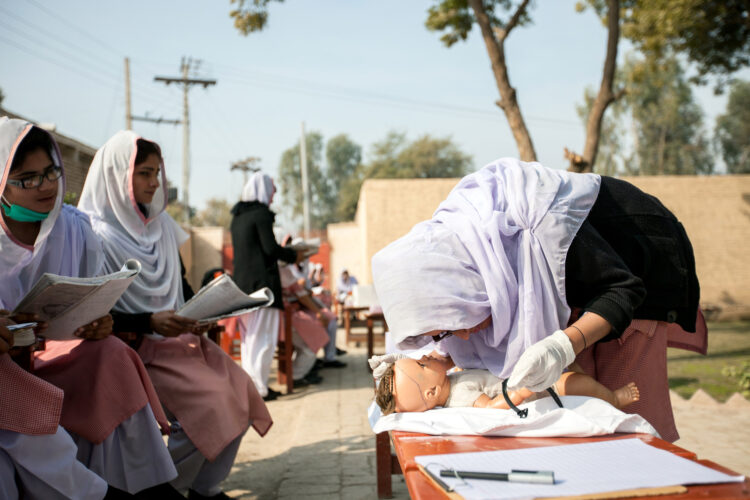
By: Gette Saduzai, (Afghan Midwife Association (AMA) Chief Executive Director), and Fahima Naziri, (AMA President), Bi Bi Samrina Siddiqui Foshanji (AMA Vice President), and Lucia Rocca-Ihenacho (Program Director, MSc Global Maternal Health, City St George University of London)
Afghanistan is experiencing one of the world’s most prolonged humanitarian crises, shaped by conflict, displacement, economic collapse, and climate-related shocks. In 2023, more than 28 million people required humanitarian assistance, with over 90% living below the poverty line. These realities have reversed two decades of progress in women’s rights and health, leaving maternal, neonatal, and child mortality among the highest globally.
Nearly one-third of maternal and newborn deaths remain preventable with timely, high-quality care. Achieving Sustainable Development Goal 3 (good health and wellbeing) and Sustainable Development Goal 5 (gender equality) is increasingly difficult amid restrictions on women’s participation, insecurity, and strained health resources. Pregnant women face malnutrition, psychological distress, and limited access to lifesaving services, while rising perinatal mental health concerns, including depression, anxiety, and trauma, are linked to chronic stress and gender inequality.
These intersecting vulnerabilities highlight the urgent need for woman-centred, rights-based maternity care in humanitarian settings. This is particularly relevant in contexts like Afghanistan, where midwives are often the primary point of contact for women and newborn.
Why midwife-led models of care matter
Globally, midwife-led care is recognised as one of the most effective and cost-efficient strategies for improving maternal and newborn outcomes. Investments in midwifery strengthen health systems, reduce mortality, and enhance women’s leadership and participation in care.
In Afghanistan, midwives are often the only skilled birth attendants in rural and hard-to-reach areas. They provide the majority of maternity care despite facing delayed salaries, shortages of essential supplies, safety concerns, and declining service quality. Their potential remains constrained by weak infrastructure and limited institutional support.
Strengthening rights-based, respectful maternity care and ensuring safe, well-resourced working environments are essential to protecting women, midwives, and other health providers, while improving maternal and newborn health outcomes.
Midwifery leadership in practice: the role of the Afghan Midwives Association
In Afghanistan, translating global evidence on midwife-led models of care into practice has depended not only on individual midwives, but on collective leadership, advocacy, and professional organisation. Established in 2005, the Afghan Midwives Association (AMA) has played a central role in strengthening midwifery leadership and advancing quality maternity care.
Through sustained advocacy, capacity building, and professional development, AMA supports midwives to deliver safe, respectful, and woman-centred care for Afghan women, newborn, and families. The association has also contributed to national efforts to strengthen reproductive, maternal, newborn, child, and adolescent health (RMNCAH) services, even amid prolonged instability and restrictions affecting the health system.
Through its work, AMA focuses on strengthening the capacity of midwives and advocating for policy and working environments that enable high-quality midwifery services, in line with ICM’s Code of Ethics and core competencies. Over time, the association has become a recognised professional voice for midwives in Afghanistan, working nationally and internationally to advance midwifery leadership and improve health outcomes for women, newborn, and families.
Midwife-led maternity care centres in Afghanistan
For years, the Afghan Midwives Association worked to turn the evidence on woman-centred, midwife-led care into reality. With the support of the Ministry of Public Health and international partners, this long-term effort led to the establishment of Midwife-Led Maternity Care Centres (MLMCCs) in Afghanistan. Since 2011, AMA has maintained sustained advocacy and strategic engagement with donors, including UNFPA, to mobilise the resources necessary for establishing and operationalising these centres. These efforts have been guided under the leadership of Pashtoon Azfar Zyaee (Founder of AMA) and Dr. Sabera Turkmani (Former AMA President; Chairperson of the AMA Research Committee; and Research Fellow at the University of Technology Sydney).
In 2021, AMA successfully launched the first MLMCC in Kabul, just one month before the fall of Kabul, marking a significant milestone for midwife-led services in the country.
More than service delivery points, MLMCCs offer safe spaces where dignity, trust, and respectful care are prioritised. As part of an international collaboration, City, University of London (St George’s), and the Midwifery Unit Network contributed technical expertise to support the development of care standards, a structured self-assessment tool, and training for midwives and clinical supervisors. These contributions strengthened the centres’ capacity to deliver consistent, high-quality, woman-centred care.
All three MLMCCs provide comprehensive maternity services, including skilled attendance at birth, routine antenatal care, timely postnatal follow-up, and referral pathways to higher-level facilities when needed. Beyond clinical care, the centres support the emotional and social wellbeing of women and their families. Led entirely by female healthcare professionals, MLMCCs provide culturally sensitive and respectful care that aligns with community values, helping women feel supported and heard throughout their maternity journey.
By enabling midwives to lead care, MLMCCs demonstrate that high-quality maternity services can be delivered without reliance on costly specialist-led models. Community-based, locally grounded approaches reduce financial and geographic barriers, while supporting continuity of care. Moreover, a comprehensive national study evaluating MLMCCs and the wider implementation of midwife-led care in Afghanistan is currently in progress. This research is being led by the Afghan Midwives Association with support from the Burnet Institute of Australia. Within this study, a specific component assessing the implementation of MLMCC care standards is being technically supported by City, University of London (St George’s). The findings are expected to generate strong evidence and further validation for the MLMCC model, with results anticipated for publication in 2026.
In 2025, the third MLMCC, established in Logar Province, supported more than 200 safe births and provided essential postnatal care to mothers and newborn.
How the centres operate
Across all three MLMCCs, care is provided to women with uncomplicated pregnancies and labour, with referrals made to obstetric units when additional support is required. Each woman is supported throughout her maternity journey by a dedicated team of professional midwives who ensure safety, continuity, and respectful care.
Each centre employs 24 midwives working across three rotating shifts, each led by an experienced Shift Supervisor. A Head Midwife oversees clinical and operational functions to ensure quality and continuity of services.
To strengthen coordination between the centres, AMA, and hosting hospitals, a Midwifery Coordinator based at the AMA main office supports professional development, conducts performance appraisals, supervises services through regular site visits, and compiles weekly monitoring reports. At a multi-centre level, a Midwife Manager consolidates data and narrative reports, ensures accountability to donors, and liaises with the Ministry of Public Health to address operational challenges. Each centre is also supported by nurses, cleaners, and support staff.
Each month, the three MLMCCs support around 600 births and reach more than 2,000 women and families with essential maternal and newborn services, with the two centres in Kabul carrying the highest caseloads.
Despite the high workload, midwives consistently deliver respectful and dignified care. According to the Afghan Midwives Association, this commitment is reflected in a patient satisfaction rate of 85%.
Navigating implementation in a complex context
Introducing a midwife-led model of care represented a new and ambitious approach in Afghanistan. Establishing MLMCCs required sustained advocacy by AMA, negotiations with the Ministry of Public Health to secure space within public hospitals, and mobilisation of donor funding. Recruiting and training midwives, particularly from remote provinces, required ongoing investment and support.
Political changes in 2021 led to temporary service suspensions and significant emotional strain for staff. Despite these disruptions, AMA renegotiated agreements, resumed services, and successfully launched additional centres. Financial constraints, institutional resistance, and limited resources continue to affect operations.
Looking ahead: sustaining quality, dignity, and access to care
These centres demonstrate how woman-centred, midwife-led models can deliver safe, respectful, and high-quality care even in highly constrained humanitarian settings. By placing midwives at the centre of care, these centres improve access to essential services while strengthening trust between women and the health system.
Sustaining and expanding this model is critical to ensuring that women and newborn in Afghanistan can access dignified maternity care. The experience of MLMCCs highlights the importance of investing in midwifery leadership, professional associations, and community-based models of care as part of broader efforts to advance health equity and social justice.
The world needs One Million More Midwives
Sign the petition and help us collect one million signatures to demand one million more midwives — and the investments needed to make it happen.