ICM Launches Global Competencies for Midwife Leaders
ICM has launched the new Global Competencies for Midwife Leaders, a major new resource to support midwives to lead at every level of health systems.
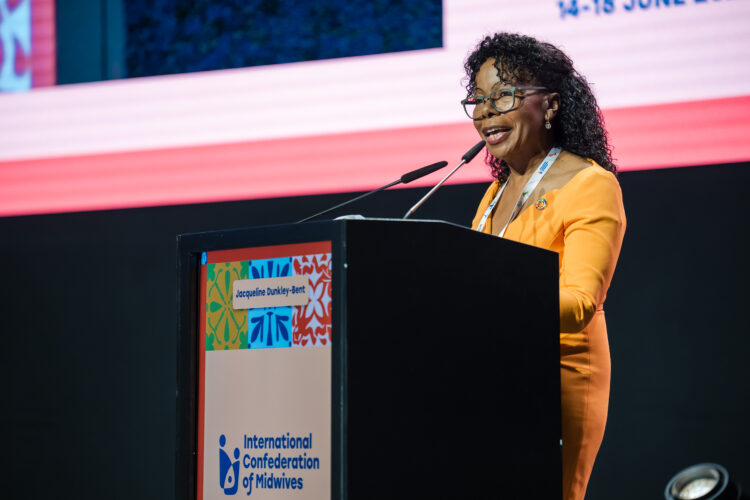
The competencies were launched during the 34th ICM Triennial Congress in Lisbon, in the session Leading from where you stand: Strengthening midwifery through leadership, led by ICM Chief Midwife Professor Jacqueline Dunkley-Bent OBE.
The launch marks an important step for the profession. It gives midwives, educators, regulators, employers, governments and professional associations a shared framework for understanding, developing and supporting midwifery leadership across different roles, settings and stages of practice.
All Midwives Are Leaders
At the centre of the new competencies is a clear message: all midwives are leaders.
Midwifery leadership is not limited to senior roles, formal titles or management positions. Every day, midwives lead through their clinical judgement, autonomous practice, advocacy, communication, ethical decision-making, quality improvement and support for women, newborns, adolescents and families.
Midwives lead when they advocate for respectful, evidence-based care. They lead when they support colleagues, mentor students, improve services, respond to crises, use data to improve care, and influence policies that affect SRMNAH. Leadership is part of midwifery practice from the beginning of a midwife’s career and continues to grow over time.
The Global Competencies for Midwife Leaders recognise this reality and provide a structured way to support it.
Why These Competencies Matter
Midwives have the knowledge, skills and professional experience to strengthen health systems and improve outcomes for women, newborns and communities. Yet midwives are still too often missing from the places where decisions are made.
Data from 80 countries show that 71% have at least one midwife in a leadership position, usually in a ministry of health, regulatory body or health facility. However, 20% of countries were unable to report on midwifery leadership, and 9% reported no midwives in leadership positions at any level.
This shows the need for clearer leadership pathways, stronger leadership development and better recognition of midwives’ influence across health systems.
Until now, the absence of globally aligned leadership competencies has contributed to inconsistent approaches to preparing and supporting midwife leaders. The new Global Competencies respond to this gap by setting out what midwifery leadership can look like in practice, from early-career leadership to senior and system-level influence.
What the Competencies Include
The framework includes 12 competency areas:
- Self-leadership, personal and professional identity
- People leadership
- Relational and communicative leadership
- Clinical and ethical leadership
- Systems and strategic thinking
- Advocacy, policy and social responsibility
- Education, mentorship and capacity building
- Quality improvement, innovation and data literacy
- Equity, inclusion and cultural safety
- Crisis and operational leadership
- Collaboration and conflict resolution
- Environmental and climate sustainability
Together, these competencies reflect the many ways midwives lead. They cover direct clinical leadership, team and service leadership, education and mentorship, advocacy, policy influence, crisis response, research, quality improvement and system strengthening.
The competencies also include four levels of proficiency: Foundational, Proficient, Advanced and Strategic. These levels show how leadership develops across a midwife’s career, from leading in day-to-day practice to influencing organisations, policies and health systems.
Developed with Midwives, for Midwives
The Global Competencies for Midwife Leaders were developed through a collaborative process led by Professor Jacqueline Dunkley-Bent OBE, with contributions from midwives and stakeholders across ICM’s global regions.
A working group of 35 members brought together experience from clinical practice, education, policy, organisational management and research. Their work was informed by a literature review, thematic analysis and consultation with ICM Regional Professional Committees.
This process helped ensure the competencies are evidence-informed, globally relevant and adaptable across different countries, cultures, resource settings and health systems.
Strengthening Midwifery Leadership Everywhere
The Global Competencies for Midwife Leaders can be used in many ways. They can support leadership development, guide professional growth, inform education and mentorship programmes, shape job descriptions, support succession planning, and help organisations assess and strengthen midwifery leadership capacity.
For individual midwives, the competencies offer a way to reflect on their own leadership and identify areas for growth. For employers and health systems, they provide a clear framework to invest in midwives as leaders. For governments, regulators and professional associations, they offer a tool to strengthen the visibility, recognition and influence of midwifery.
The launch of the Global Competencies for Midwife Leaders is a strong statement about the future of the profession. Midwives are already leading from where they stand. These competencies will help ensure that leadership is recognised, supported and strengthened at every level.
By investing in midwife leaders, health systems invest in better care, stronger services and a future where midwives can use their full expertise to improve the lives of women, newborns, adolescents and communities.